

Critical alert response time
Before: 18 min
After: 2 min
-89%
Faster incident response
Implemented Telegram event routing with severity logic and escalation automation.
Critical alert response time
Before: 18 min
After: 2 min
-89%
SLA breach frequency
Before: High
After: Low
Large reduction
Escalation completion
Before: 62%
After: 96%
+34 pts
Section 1 - Client Problem
Section 2-3 - Context and Goal
A distributed team needed immediate, role-specific alerts for customer and operations events without adding operational overhead.
Create a centralized Telegram alerting framework with event severity routing and contextual payload formatting.
Section 4-5 - Workflow and Architecture
Unified event bus -> severity classifier -> Telegram channel router -> escalation workflow.
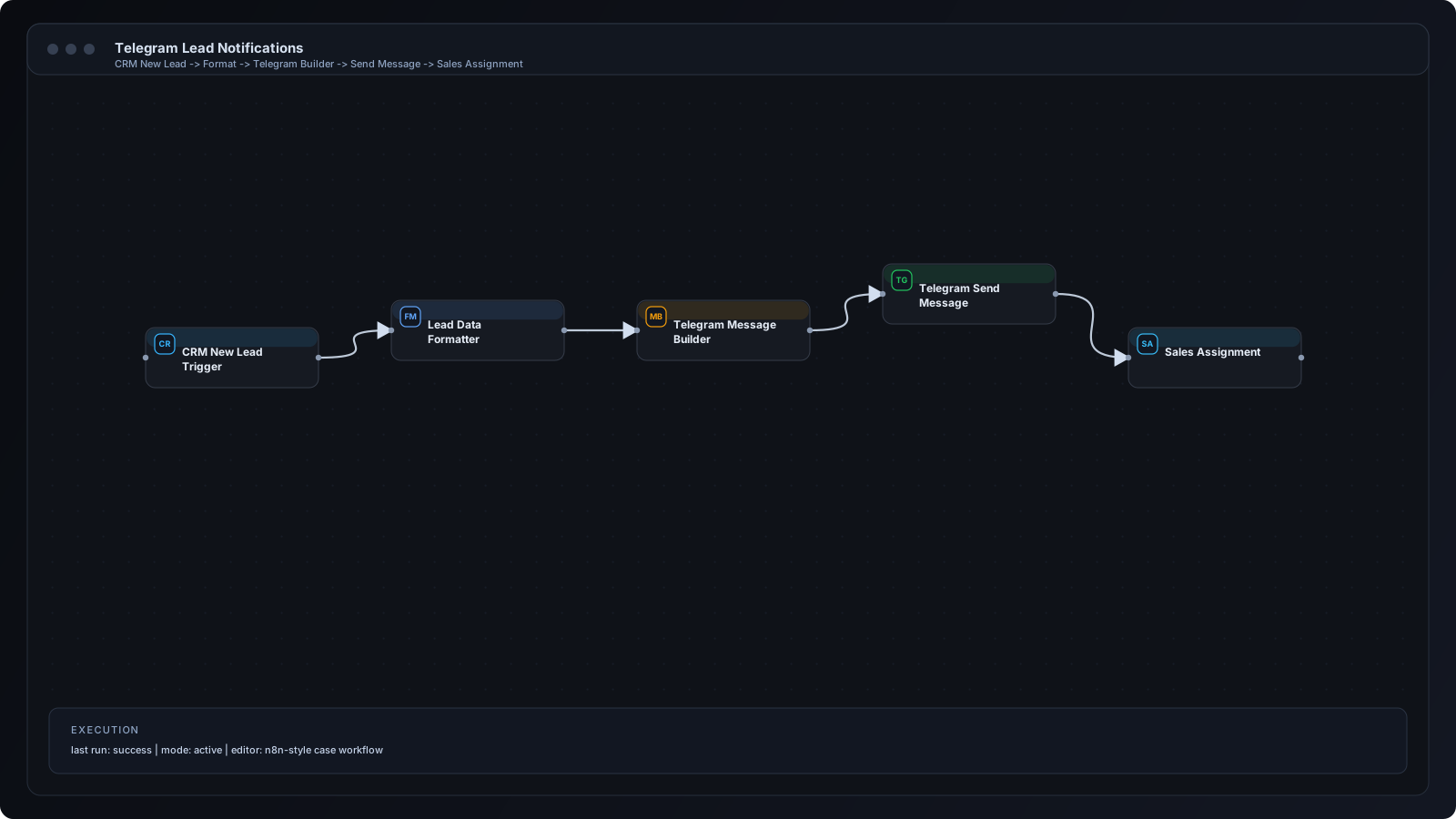
Recommended diagram: Event Source -> Classifier -> Message Builder -> Telegram Channel -> Escalation Delay -> Manager Alert -> Resolution Log.
Section 6 - Step by Step Workflow
Step 1
Operational event is emitted by source system.
Step 2
n8n receives event webhook and enriches metadata.
Step 3
Classifier assigns severity and team ownership.
Step 4
Message formatter builds actionable Telegram payload.
Step 5
Alert is routed to primary team channel.
Step 6
Unacknowledged alerts escalate to management channel.
Step 7
Resolution status is written back to tracking table.
Section 7 - n8n Breakdown
Webhook Node
Captures incoming events from multiple systems.
Switch Node
Routes events by type and severity.
Function Node
Formats consistent alert templates.
Telegram Node
Sends messages to mapped channels.
Wait Node
Delays escalation check for acknowledgment window.
IF Node
Triggers escalation when no acknowledgment exists.
Integration icons and tooling used in this implementation.
 Telegram
 n8n
n8n Webhooks
 Slack
SlackSection 8 - Results and Metrics
| Metric | Before | After | Impact |
|---|---|---|---|
| Critical alert response time | 18 min | 2 min | -89% |
| SLA breach frequency | High | Low | Large reduction |
| Escalation completion | 62% | 96% | +34 pts |
Section 9 - Implementation Challenges
Introduced severity scoring and throttling rules before channel dispatch.
Implemented reusable message templates per event type and team role.
Added acknowledgment tracking and resolution logging table.
Section 10 - Lessons Learned
Section 11 - FAQ
Yes. Routing can include region, time window, ownership, and severity.
Yes. Interactive actions can trigger follow-up automation paths.
Yes. Telegram and Slack can run in parallel from the same event flow.
Most alerts are delivered in seconds after event ingestion.
Share your workflow stack and current bottlenecks. We will design a practical automation architecture with implementation priorities.