


Triage time
Before: 12 min
After: 2.5 min
-79%
Faster triage
Built confidence-scored AI classification with deterministic fallback branches.
Triage time
Before: 12 min
After: 2.5 min
-79%
Routing accuracy
Before: 71%
After: 92%
+21 pts
Manual triage volume
Before: 100%
After: 28%
-72%
Section 1 - Client Problem
Section 2-3 - Context and Goal
A high-growth operations team needed consistent prioritization and routing of inbound events while maintaining explainability for decisions.
Deploy an AI-assisted decision engine that classifies intent, predicts priority, and routes workflows with confidence thresholds.
Section 4-5 - Workflow and Architecture
Classifier + confidence threshold logic with deterministic fallback branches.
Recommended diagram: Intake -> Context Fetch -> AI Classifier -> Confidence Check -> Auto Route / Manual Review -> Decision Log.
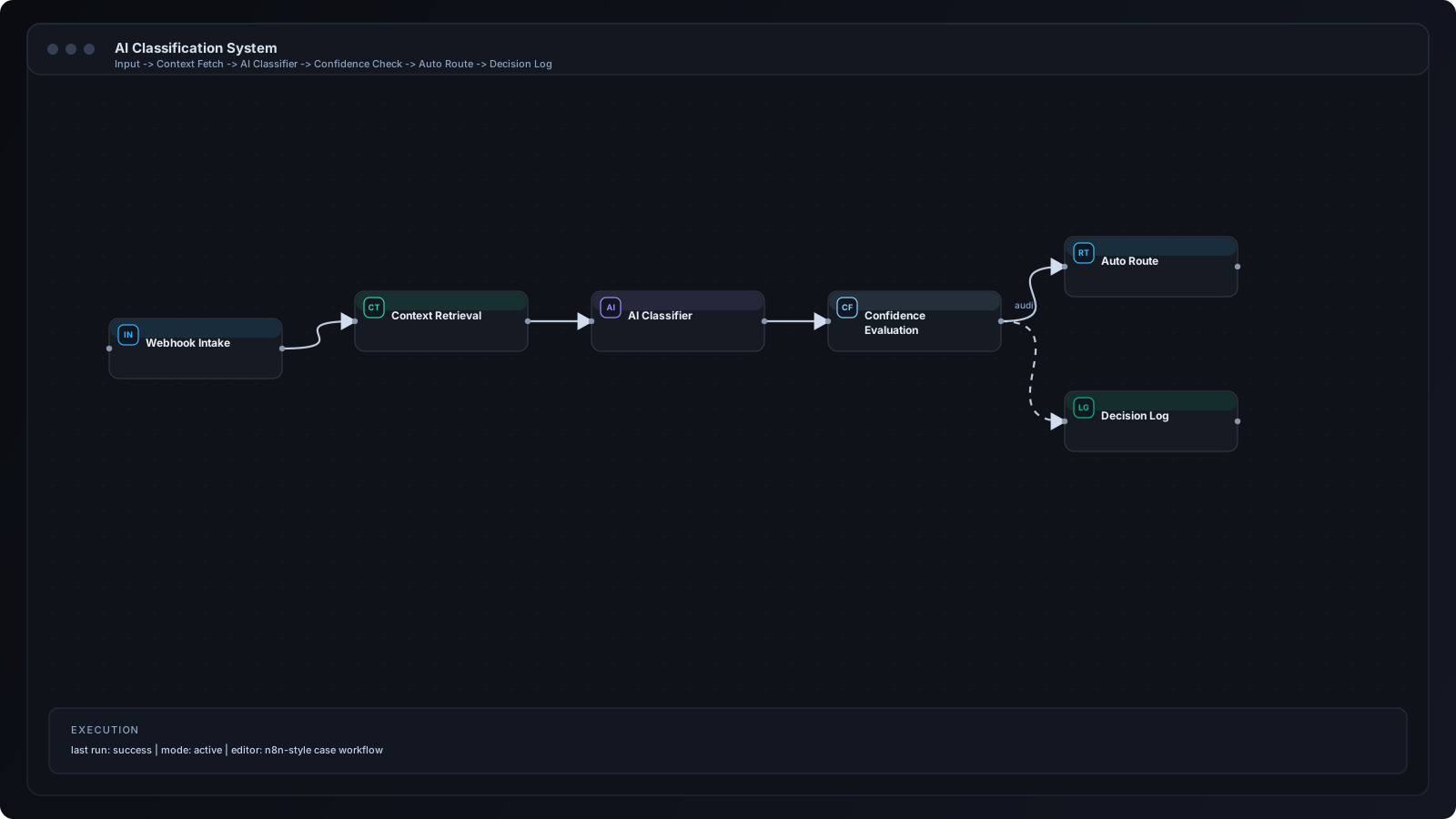
Section 6 - Step by Step Workflow
Step 1
Inbound request enters automation intake.
Step 2
Enrichment fetches account and behavioral context.
Step 3
OpenAI model classifies request type and urgency.
Step 4
Confidence gate checks score against threshold policy.
Step 5
High-confidence requests auto-route to correct workflow.
Step 6
Low-confidence requests are sent to manual triage queue.
Step 7
All decisions are logged with input and output metadata.
Section 7 - n8n Breakdown
Webhook Node
Receives inbound request payload.
HTTP Request Node
Pulls account context from CRM APIs.
OpenAI Node
Generates classification and recommended action.
IF Node
Evaluates confidence threshold policy.
Execute Workflow Node
Routes to downstream workflow branch.
Data Store Node
Stores decision trace for auditing.
Integration icons and tooling used in this implementation.
 OpenAI
 n8n
n8n HubSpot
 Webhooks
Section 8 - Results and Metrics
| Metric | Before | After | Impact |
|---|---|---|---|
| Triage time | 12 min | 2.5 min | -79% |
| Routing accuracy | 71% | 92% | +21 pts |
| Manual triage volume | 100% | 28% | -72% |
Section 9 - Implementation Challenges
Added manual routing branch and periodic prompt retraining from reviewed samples.
Stored reason codes and confidence levels in decision logs.
Cached non-volatile context and parallelized external API requests.
Section 10 - Lessons Learned
Section 11 - FAQ
Yes. Thresholds are configurable by workflow type and business risk profile.
Monthly reviews are recommended for drift detection and prompt optimization.
Yes. Manual override controls are part of the operating model.
Yes. Inputs, confidence, outputs, and final route are fully logged.
Share your workflow stack and current bottlenecks. We will design a practical automation architecture with implementation priorities.